Insulation Materials
Rock wool, glass wool, PIR and PU selected for the fire strategy, U-value, acoustics and cavity depth of each roof and wall assembly.
- Materials
- Rock wool · glass wool · PIR/PU
- Fire
- Non-combustible options
- Format
- Rolls · boards · panels
Overview
An insulated metal envelope has to balance several requirements at once: thermal performance, fire resistance, acoustic absorption, moisture control and the available construction depth. No single material is best at everything, so the assembly should be selected against the project's priorities.
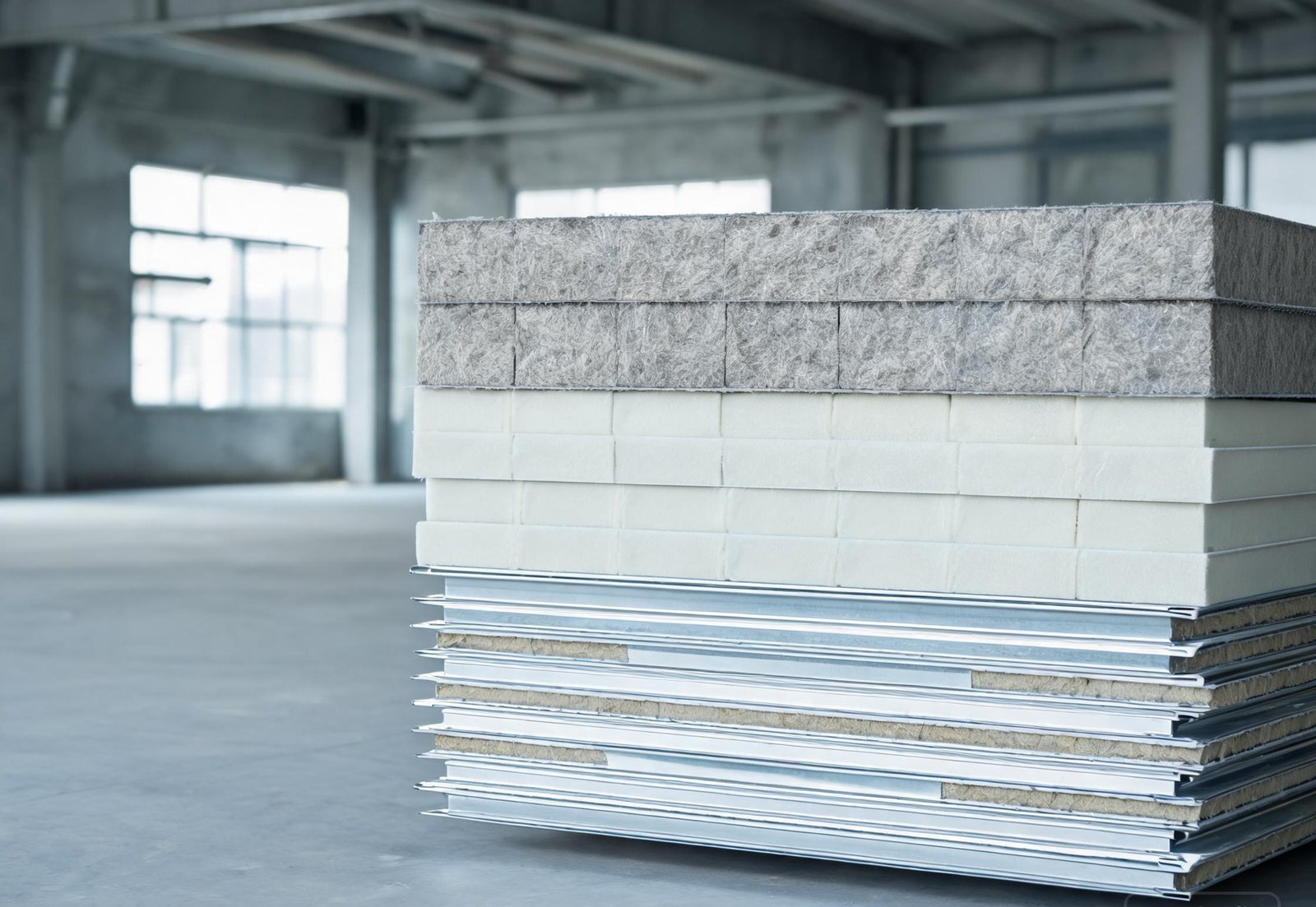
Insulation for industrial envelopes controls heat transfer, surface condensation and noise. Rock wool and glass wool are mineral fibre products; PIR and PU are closed-cell rigid foams with lower thermal conductivity.
Rock wool is non-combustible and tolerant of high temperatures, making it suitable for buildings with strict fire requirements. Glass wool is lighter and provides good acoustic performance in roof and wall cavities. PIR and PU achieve a higher thermal resistance per millimetre, which helps where cavity depth is limited.
Product benefits
- Reduces heat loss and cooling demand through roof and wall
- Mineral wool options support non-combustible assemblies
- Acoustic absorption for rain noise and internal reverberation
- PIR/PU delivers high R-value in shallow cavities
- Faced and unfaced formats for different build-ups
VIVON supplies insulation as part of the roof and wall build-up, with facings, vapour control and fixing details considered together. Target U-values and condensation risk should be checked for the actual assembly, not the material in isolation.
Typical specifications
Values below are indicative ranges. Final specifications are confirmed against project drawings, loads and local requirements.
| Materials | Rock wool, glass wool, PIR, PU |
|---|---|
| Formats | Rolls, bats, boards, sandwich panel cores |
| Density | Project-specific by material and application |
| Thickness | Selected to achieve the target U-value |
| Thermal conductivity | Typical range 0.020–0.045 W/m·K depending on material |
| Fire performance | Non-combustible mineral wool; PIR/PU with flame-retardant grades |
| Facing options | Foil, glass tissue, vapour-control membrane |
| Applications | Metal roof, wall cavity, sandwich panels, cold rooms |
Selection guidance
Include the following information in an inquiry so the correct system can be confirmed without a second round of questions.
- Target U-value and energy performance
- Fire class and non-combustible requirement
- Internal and external humidity conditions
- Available cavity depth and structural zone
- Acoustic performance target
- Compressive strength for floors or walkable areas
- Vapour control and condensation risk
Typical applications
Frequently asked questions
Which insulation gives the best U-value?
PIR and PU generally provide the highest thermal resistance per millimetre because of their low thermal conductivity. Mineral wool needs a greater thickness for the same U-value but offers non-combustible performance and acoustic benefits. The right choice balances U-value, fire strategy and cavity depth.
Is rock wool non-combustible?
Rock wool is a mineral fibre insulation and is available in non-combustible grades. The fire performance of the complete roof or wall assembly also depends on facings, membranes, fixings and the supporting structure, so the assembly should be assessed as a system.
How is condensation risk managed?
Condensation is managed through the combination of insulation, vapour control layer, ventilation and detailing. The position of the dew point should be checked for the actual assembly and climate. Vapour-tight facings and sealed joints are as important as the insulation thickness.
Specify insulation materials for your project.
Send the building type, location, drawings and required performance. You will receive a coordinated recommendation and quotation.