Daylight panels are usually the first part of an industrial envelope to show their age. In humid, high-UV markets, a panel that looks correct on a quotation can yellow, chalk or leak within five years — not because the material is wrong in principle, but because the specification was never matched to the climate.
Start with the climate, not the datasheet
Global irradiance, humidity and night-time temperature swing all act on a polyester panel at the same time. A formulation that performs in northern Europe may lose light transmission quickly in Southeast Asia, the Gulf or coastal Africa.
Ask for the resin chemistry, the UV stabiliser loading and the surface protection in writing. A generic “anti-UV” claim is not a specification, and it cannot be verified after the panels arrive on site.
Resin and surface protection
For most industrial roofs, three families cover the majority of requirements:
- Isophthalic polyester — balanced cost and weather resistance for temperate and moderate-UV sites.
- Vinyl ester — better resistance to humidity, chemical splash and hydrolysis; the default for coastal and process plants.
- Acrylic or PVDF surface film — a sacrificial layer that keeps gloss and light transmission longer in high-UV locations.
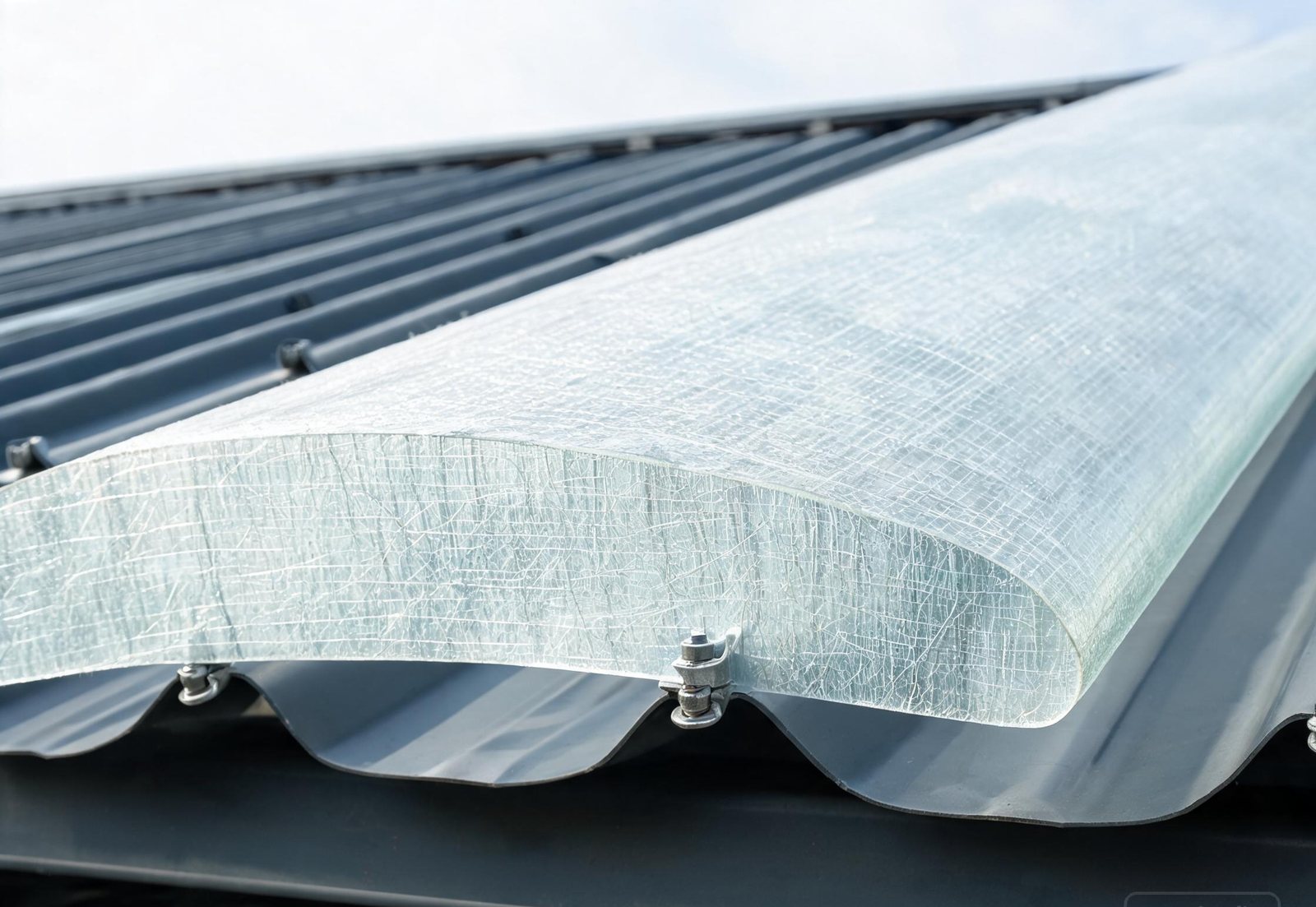
Thickness should follow the profile’s span and walkability requirement, not the price target. A 1.2 mm panel on wide purlin spacing will deflect and fatigue, even if the resin itself is correct.
Detailing that keeps panels watertight
Most leaks start at the interface, not in the sheet. Specify matching closure strips, a compatible sealant and fasteners with EPDM washers; allow for thermal movement at every fixing; and keep the panel end clear of the gutter line.
The mounting sequence matters too. Panels should be installed with the protective film removed, in the cooler part of the day, and never over-stressed to close a tolerance error in the steel structure.
Key takeaways
- Specify resin, UV package and surface protection — not just thickness and colour.
- Match the panel to the site’s UV and humidity exposure; vinyl ester for coastal and chemical environments.
- Treat fixings, sealants and flashings as part of the daylight system, not as accessories.